Description
Product Summary
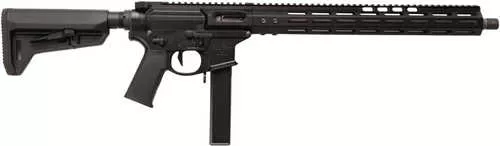
The Gen 4 Noveske9 Rifle is chambered in 9×19 mm and features a 16″ barrel with a 1/2×28 Noveske Thread Protector. The upper receiver is a Gen 4 precision machined billet receiver from 7075-T6 and features a anti-rotation interface with the handguard. It features a Noveske Marked Geissele Super Badass charging handle. The lower receiver is a Gen 4 precision machined billet receiver and features a Geissele Super MCX SSA trigger. The stock is a Magpul SL-K Stock and the grip a Magpul MOE-K. It has MBUS Pro folding sights.
BrandNoveske
CategoryTactical Rifles
Caliber9mm Luger
ModelNoveske 9
Stock FinishBlack
ActionSemi-Auto
SightsNone, Optic Ready
Capacity32+1
MuzzleThreaded
GripsMOE-K
HandRight
Receiver FinishBlack Anodized
Receiver Material7075 T6 Aluminum
SafetyAmbidextrous Safety Lever
Stock DescriptionMagpul SL-K
Stock Finish GroupBlack
Stock MaterialSynthetic
Thread Pattern1 / 2″-28 tpi
Trigger Geissele MCX
Twist1:12″
Barrel FinishBlack
Barrel Length16″
Caliber Dictionary
The Below Information Has Been Provided From Our Gun Caliber Dictionary And Is Meant For Informational Purposes Only. It Is Not Intended to Describe The Unique Specifications For This Ammunition.The 9mm Luger (9X19mm, Parabellum, P08) was developed in Germany in 1902. Widely used in both world wars, it is the most popular pistol cartridge in the world, now widely used by innumerable law enforcement agencies and militaries (including our own) in both pistols and submachineguns. The controversy over its “stopping power” will never go away, but its attribute is that it is much easier to shoot accurately than larger cartridges with greater power…but more recoil. Advancements in bullet design for law enforcement and personal defense have narrowed the gap considerably. The 9mm Luger is a world standard, chambered by virtually all makers of semiautomatic pistols, with a myriad of factory loads. The most standard is probably a 115-grain load at 1160 fps, with common bullet weights ranging from 95 to 147 grains, and +P loads at higher velocity. — Craig Boddington